When the WNBA Won’t Say What a Woman Is, It Shouldn’t Act Shocked by the Circus
The CBA Says “Women.” It Never Defines the Word
The WNBA wants two things at once. It wants to be treated as a serious professional league. And it wants to treat the most basic rule of a women’s league — who is allowed to play — as too delicate to answer in plain English.
That is not a culture-war hallucination. It is in the paperwork.
The league’s collective bargaining agreement says only women are eligible to play in the WNBA. Then it stops. It does not define “woman.” It does not say biological sex. It does not say gender identity. It does not say how the rule would be checked, who would check it, or what happens if someone tests the language. A 400-page labor deal can define a rookie, a veteran, and a regular-season game. It will not define the category the entire product is built on.
Commissioner Cathy Engelbert has called the subject “complex and nuanced.” The league’s anti-hate task force met, talked, and produced the usual statement: more conversations, no immediate eligibility issues, and a denunciation of “bad-faith” people asking the question. That is not a policy. That is a press release pretending to be a spine.
If you run a women’s league and you cannot say what a woman is, you invited the backlash. Not “women” as a species. The league office. The union. The players and coaches who treat a dictionary definition as an act of war. They chose the fog. Fog is what they got.
Enes Kanter, Natasha Cloud, and the Shirt That Got Him Thrown Out
On August 23 in Chicago, former NBA center Enes Kanter Freedom sat courtside at the Sky-Fever game in a black shirt that read: “WOMAN noun. adult human female.” Late in the third quarter, after Natasha Cloud scored, Cloud walked toward him, pointed, and started yelling. Kanter stood, arms out, and took a step toward the floor. Security and Sky players got between them. Officials had him ejected. He held the shirt out on the way out and later posted that he had been kicked out of a WNBA game for supporting women.
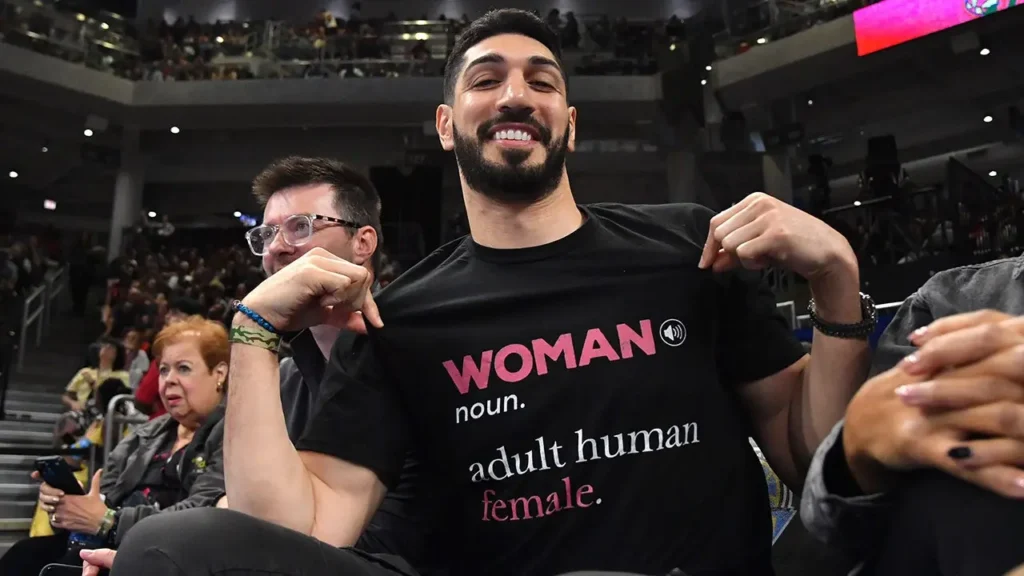
Cloud later wrote that trans people are part of her “community and tribe” and “will always be protected by me.” Sky coach Tyler Marsh said he respected her for standing on her beliefs. The team treated Kanter as a “fan incident.” The crowd booed him out. That is the official story the league prefers: a heckler got what he deserved.
Call Kanter a showman if you want. He is one. He and Royce White declaring for the 2027 WNBA Draft was a stunt designed to force a yes-or-no answer. Stunts work when the other side refuses to answer. League sources now say those two will not be allowed into the draft. Fine. Then write the rule down where the public can read it. Do not hide behind “only women are eligible” while treating the definition of woman as hate speech.
Kanter did not invent the controversy. The WNBA did that by leaving the door open and then scolding anyone who walked up to it. A shirt with a biological definition should not be more dangerous in a women’s arena than a player leaving the court to confront a spectator. If Cloud can police the baseline for ideology, the league can police eligibility for sex. It chose the first and ducked the second.
That is why a lot of people, including this site, are with Kanter on the core point even if they would not stage the courtside theater the same way. Women’s sports exist because male and female bodies are not the same. If that sentence is banned in the building, the building is no longer serious about women’s sports.
Angel Reese’s Eighth Technical Was Rescinded. The Pattern Wasn’t
Angel Reese is not on the Chicago Sky anymore. She is with the Atlanta Dream. On Friday she picked up what officials called her eighth technical of the season against the Portland Fire after getting tangled with Carla Leite on a box-out. Under WNBA rules, eight technicals in the regular season means an automatic one-game suspension. That would have sat her for Sunday against the first-place Minnesota Lynx. The Dream appealed. The league rescinded the technical within hours. She is back at seven and will play.
Same movie as earlier this season with Caitlin Clark. Eighth tech. Immediate panic. League office erases it. Move along. Reese already served a technical suspension last year with Chicago. She is one whistle from sitting again. That is sloppy player discipline, and the league looks weak when the automatic penalty only becomes automatic after the PR department checks the calendar.
Do not confuse that with the eligibility fight. One is officiating and star management. The other is whether the product still means what it says on the jersey. The WNBA keeps asking the public to care more about technical fouls and “hate” task forces than about the category that makes the league possible.
This is what institutional cowardice produces. Write the Rule or Keep Getting the Circus
The honest version of the debate is not “all women caused this.” Plenty of female athletes — Sophie Cunningham among them — have said out loud that women’s sports should stay women’s sports. They caught heat for it from inside their own industry. That should tell you who is driving the official line. It is the league, the union, and the activist core that treats sex as optional and dissent as violence.
The dishonest version is the one the WNBA keeps selling: there is no issue because no transgender woman is on a roster right now, so anyone talking about the rule is acting in bad faith. That is like saying a lock is unnecessary because nobody has walked in yet. The lock is the rule. If you will not write it, you do not have it. A future challenge does not need today’s roster. It needs today’s language.
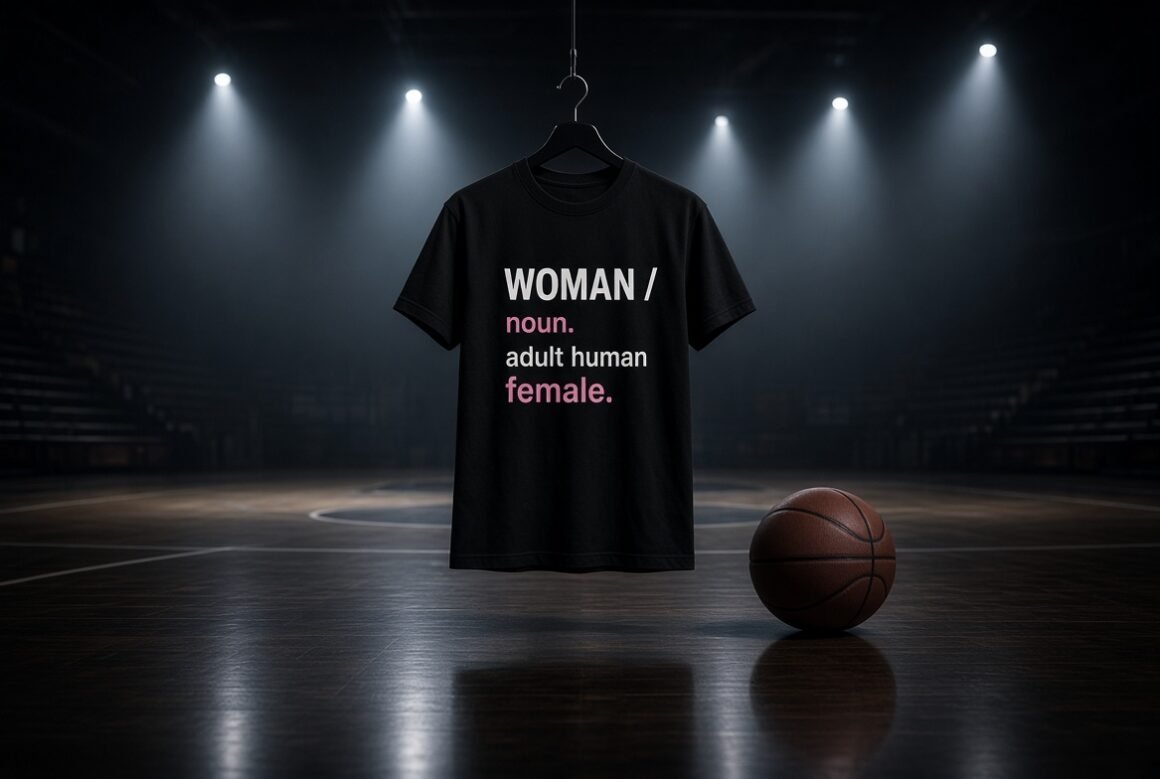
A women’s league that cannot define woman is not being kind. It is being lazy. It is asking paying customers to accept a product whose boundary is a vibe. Then it acts stunned when a former NBA big man sits down with a dictionary on his chest and the building melts.
Kanter forced the question. Cloud answered with a confrontation. The league answered with an ejection and another statement. None of that is a definition.
Until the WNBA can say the quiet part in public — women’s basketball is for female athletes — it will keep getting the backlash it earned. Not because the country hates women’s sports. Because a lot of the country still knows what the word means, and it is tired of being told that knowing is the scandal.

Big John
I have an Associates & Bachelors Degree in Criminology with a minor in Political Science. I've been blogging since around 2017, my work has been viewed by over a million people. My works from FinFlam and FinFlam Sports have been talked about on many of the largest news outlets in the world from Reuters, USA Today, Politifact, CheckYourFact.com, The Quint and many other outlets.


You May Also Like
At 5-1 How Legitimate are the Tampa Bay Buccaneers in 2025?

With Washington Retiring Their Name Could The Kansas City Chiefs Be Next?