UFL 2026 Full Season Recap: Louisville Kings’ Fairy-Tale Title, Attendance Struggles, the NFL Pipeline, and the Marketing Gap That Still Haunts Spring Football
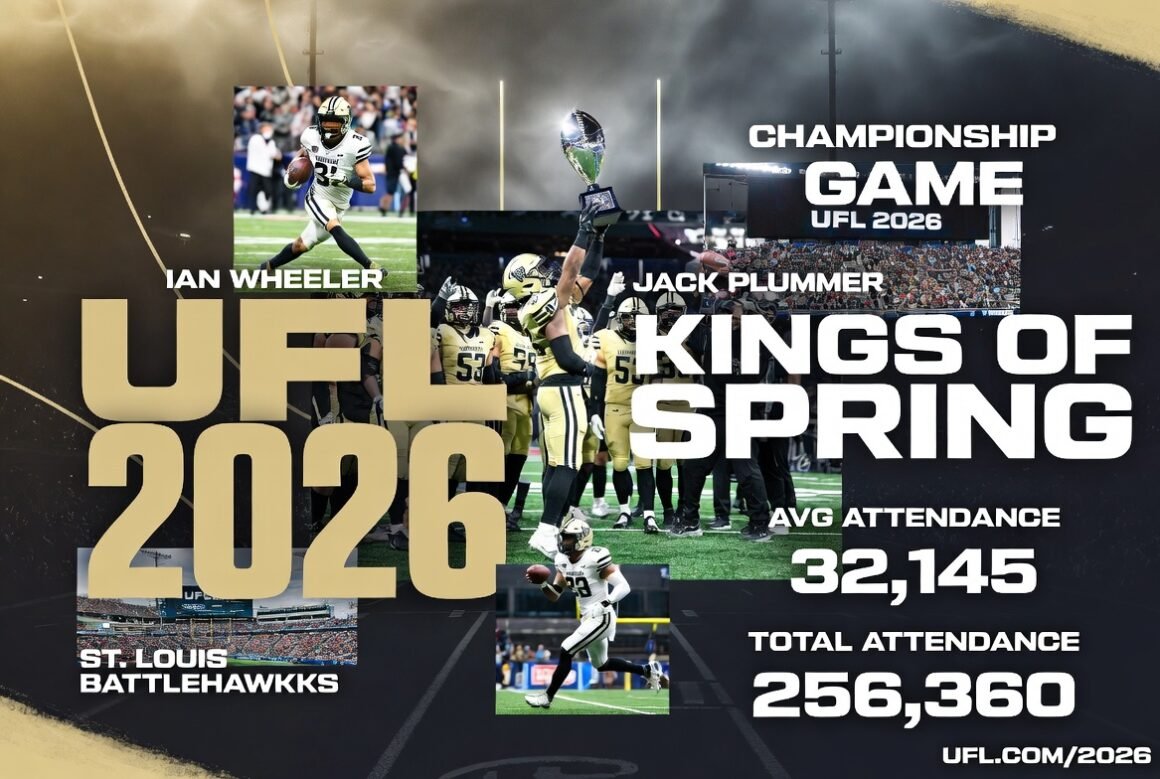
The 2026 United Football League season is in the books, and if you blinked, you might have missed one of the better underdog stories in recent spring football history. The Louisville Kings — a brand-new franchise in year one — went from an 0-3 start to United Bowl champions, beating the DC Defenders 27-20 in a sold-out Audi Field championship game. Running back Ian Wheeler took home United Bowl MVP honors. Quarterback Jack Plummer was named league MVP. And the entire league once again proved it is the best developmental pipeline outside the NFL.
But the numbers tell a more complicated story. Attendance dropped. Viewership held steady or rose slightly. Marketing still lags behind the Vince McMahon XFL spectacle days. And the long-term question remains the same: Can Mike Repole’s version of spring football grow beyond a solid niche product?
Here’s the full, no-spin breakdown of the 2026 UFL season.
The Championship Story: From 0-3 to Kings of Spring Football
Louisville’s path was pure sports-movie material. The Kings opened the season 0-3, looking like expansion fodder. Then they flipped a switch. They won eight of their final nine games, including a three-game sweep of the DC Defenders during the regular season and playoffs.
In the United Bowl on June 13 at Audi Field, the Kings trailed early, weathered injuries (Defenders quarterback Jordan Ta’amu went down with a shoulder injury), and leaned on their ground game. Wheeler delivered the defining play — a 44-yard go-ahead touchdown run early in the fourth quarter. James Robinson punched in another score. The defense forced a critical fourth-down incompletion late, and Louisville ran out the clock for a 27-20 victory.
Wheeler finished with 81 rushing yards and the championship-clinching score. Plummer, the league MVP, provided steady leadership all season. First-year head coach Chris Redman’s locker-room speech after the win became one of the most-watched pieces of UFL content on YouTube. The Kings became the first expansion team in the modern UFL era to win a title in their inaugural season.
That story alone should have been marketing gold. It was not fully capitalized on.
Attendance: The Good, the Bad, and the St. Louis Exception
League-wide regular-season attendance averaged about 10,500 fans per game — a roughly 20% drop from 2025. Mike Repole’s preseason goal was around 10,000, so they hit the number, but the trajectory is concerning after relocating three teams (Memphis, Michigan, and San Antonio moved to Columbus, Louisville, and Orlando).
Team averages told the real story:
- St. Louis Battlehawks: 23,239 (still the gold standard)
- Louisville Kings: 11,195
- Columbus Aviators: 10,362
- Orlando Storm: 9,830
- DC Defenders: ~9,000
- Birmingham Stallions: 8,248
- Dallas Renegades: 6,449
- Houston Gamblers: 5,683
St. Louis remains the model. The Battlehawks drew the biggest crowds again and made the playoffs for the third straight year (6-4 regular season, lost in the semifinals to Louisville 29-20). Everything else is a mixed bag. Birmingham’s big stadium felt empty at times. Dallas and Houston continue to struggle to fill seats. Louisville and Columbus showed promise as new markets, but the overall decline after market realignment is a red flag.
Viewership: Quietly Holding Steady
Television was the brighter spot. The league averaged roughly 674,000 viewers across ESPN networks and Fox Sports — a slight uptick from 2025. ABC games performed especially well (up around 10-14% in some reports). The United Bowl itself drew nearly 988,000 viewers on ABC, roughly flat with the previous year despite moving to a Saturday afternoon window.
Fox Friday-night games saw a modest bump. Digital and social content (especially All-Access locker-room videos and top-10 plays packages on the official UFL YouTube channel) continued to perform solidly. The league still reaches tens of millions of unique viewers over a season, which is respectable for spring football.
The NFL Pipeline Remains the Real Strength
This is where the UFL continues to deliver. Within days of the United Bowl, more than 20 players had already signed with NFL teams. By mid-July the number climbed past 23, with dozens more getting workouts. Every phase of the game was represented — receivers, offensive linemen, linebackers, edge rushers, and running backs like Wheeler.
The league’s value proposition is clear: give overlooked or second-chance talent a high-level platform in the spring, and NFL teams will take notice. That pipeline is the strongest argument for the UFL’s continued existence.
Marketing Under Repole vs. the Vince McMahon Era
Here’s the hard truth. The product on the field is better than the original XFL and more sustainable than the old USFL experiments. The rules are cleaner. The coaching is solid. The games are competitive.
But the marketing and spectacle still fall short of what Vince McMahon brought in 2001 and again in the later XFL iteration. McMahon understood showmanship, larger-than-life characters, and constant noise. Repole’s approach is more business-like and football-first — which is fine for purity, but it leaves the league quieter than it needs to be to break through the spring sports clutter.
YouTube All-Access content (locker-room speeches, player features) is good. Social engagement is decent. Yet the constant cultural conversation that once surrounded the XFL is missing. Spring football needs more personality, more year-round presence in its markets, and more creative ways to turn competitive games into must-watch events.
Expansion and the Road Ahead
Mike Repole has been transparent. There’s an “80 percent chance” the same eight markets return in 2027. Oklahoma City is locked in for 2028 as an expansion team. Other cities being discussed include New England, Austin, Raleigh, parts of South Carolina, Queens, Utah, Boise, and New Mexico.
The goal is 16 teams by 2035. That is ambitious and realistic only if attendance and local engagement improve. Keeping Birmingham in a smaller, more intimate venue is already under discussion.
What Worked in 2026
- Competitive balance and a compelling championship story
- Strong NFL pipeline
- Solid (if not spectacular) national television numbers
- New markets like Louisville showing real potential
- St. Louis continuing to prove a passionate fan base exists
What Didn’t Work
- Overall attendance decline after relocation
- Inconsistent local marketing and year-round presence
- Lack of the spectacle and personality that once made spring football appointment television
- Some markets (Dallas, Houston, Birmingham) still struggling to build consistent crowds
Bottom Line
The 2026 UFL season was a success on the field and a mixed bag off it. Louisville’s title run gave the league a feel-good story. The talent pipeline to the NFL remains elite. Viewership held the line. But attendance trends and the ongoing marketing gap are the hurdles that will decide whether this version of spring football becomes a permanent fixture or another chapter in the long list of failed attempts.
Mike Repole has the money and the long-term vision. The product is clean and competitive. Now the league needs to find a way to make more people care — not just the die-hards who already show up in St. Louis and the new converts in Louisville.
Spring football is still fighting for relevance. 2026 proved the on-field product can deliver. The off-field product still has work to do.
What do you think, FinFlam Nation? Was Louisville’s run the highlight of the spring, or are the attendance numbers a bigger warning sign? Drop your take below.
Big John – FinFlam Sports – No spin. Just the real story.

Big John
I have an Associates & Bachelors Degree in Criminology with a minor in Political Science. I've been blogging since around 2017, my work has been viewed by over a million people. My works from FinFlam and FinFlam Sports have been talked about on many of the largest news outlets in the world from Reuters, USA Today, Politifact, CheckYourFact.com, The Quint and many other outlets.

You May Also Like

Is Tony Romo a Hall of Fame Player? Analyzing His Legacy
Cam Newton Playing for the Chargers?