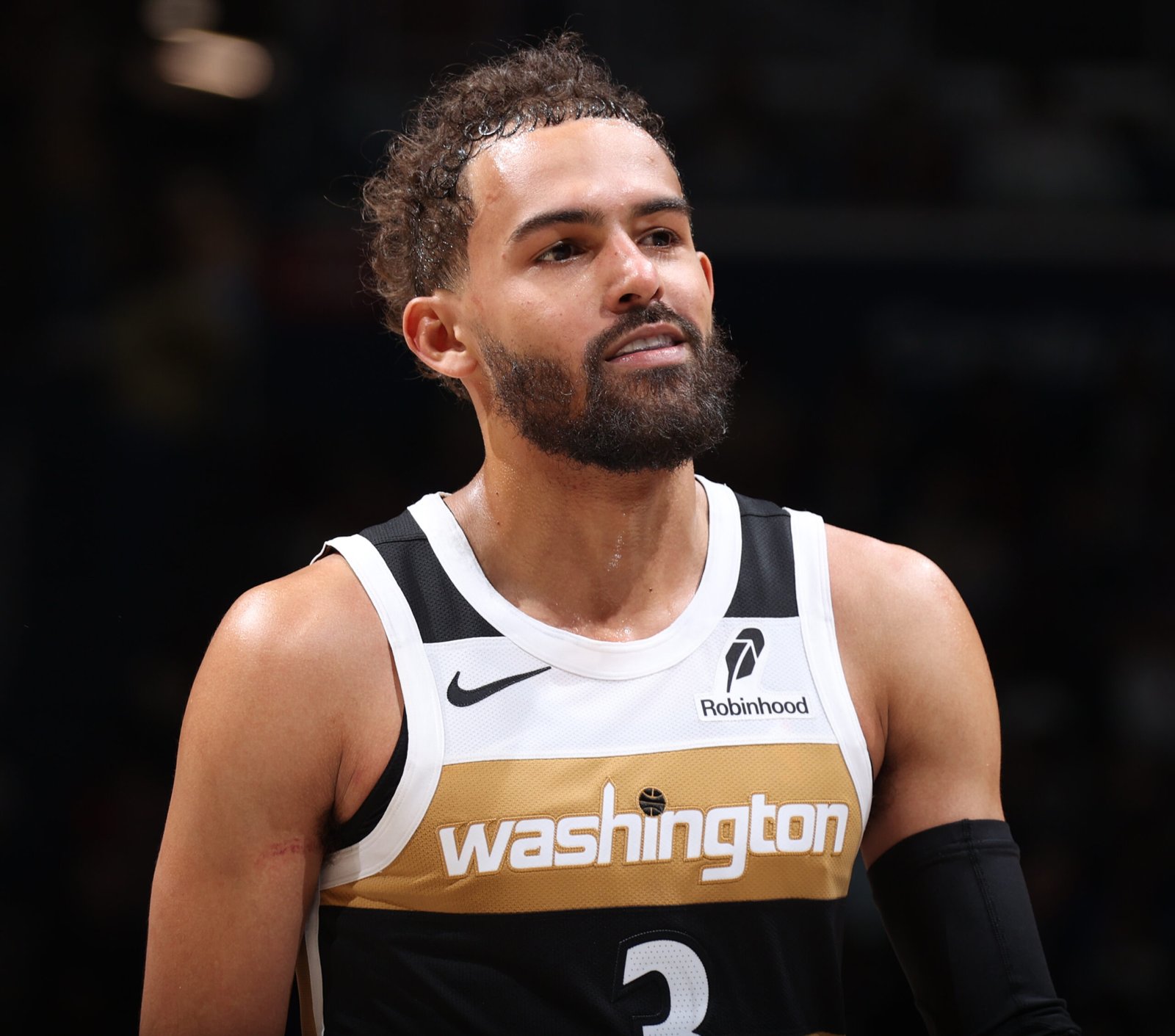
The Wizards will Regret Extending the contract of Trae Young
The news broke Monday via ESPN’s Shams Charania: Trae Young intends to sign a four-year, approximately $212 million deal to stay with the Washington Wizards, with a player option in the final year. The four-time All-Star declined his $49 million player option for 2026-27 to lock in long-term security in D.C.
This comes after Young was traded from Atlanta to Washington in early January 2026. He appeared in just a handful of games for the Wizards amid knee, quad, and back issues before being shut down for the remainder of the 2025-26 season.
The Wizards, who also acquired Anthony Davis via trade from Dallas earlier in the year, are no longer in pure rebuild mode. With a young core featuring Alex Sarr, Bilal Coulibaly, Kyshawn George, and others, plus the No. 1 overall pick in Tuesday’s NBA Draft, Washington is betting big on veteran star power to accelerate its timeline.
But is Young worth the massive investment? And what are the realistic chances this duo pushes the Wizards deep into the playoffs—especially with AD in the mix? The honest answer involves more caution than hype.
The Case for the Deal
Young remains an elite offensive engine. Career averages sit near 25.5 points and 9.8 assists per game. Even in a limited and injury-marred 2025-26 campaign (roughly 15 games), he showed flashes of the playmaking and scoring gravity that made him a perennial All-Star.
Pairing him with Anthony Davis creates intriguing two-man chemistry potential. Trae’s pick-and-roll mastery with a healthy AD could be devastating—Young as the maestro, AD as the finisher, rebounder, and rim protector. The Wizards’ young wings and bigs (Sarr especially) could benefit from playing alongside proven stars who demand attention.
For a franchise that has languished near the bottom of the East, this is a statement of intent. Locking in a 27-year-old (turning 28 in September) floor-raiser gives the front office cover while the draft pick and young talent develop.
The East has been top-heavy for years; a motivated, healthy Wizards team with two stars could sneak into the play-in or even the playoffs in 2026-27.
The Very Real Concerns for Trae Young
The counterarguments are substantial and center on two words: availability and fit.
Young’s 2025-26 season was a disaster health-wise. Knee issues lingered from the prior year, then quad and back problems sidelined him after limited action with his new team. AD’s injury history is even more notorious—multiple calf strains, groin issues, hand/finger problems, and more in recent seasons.
Both players missed the vast majority of games after their respective trades to Washington.
Paying roughly $53 million annually (starting around 30% of the projected salary cap) to a player with recent durability questions is a massive commitment. It limits future flexibility and puts enormous pressure on the supporting cast and medical staff.
Defensively, Young has long been a liability. The Wizards already rank poorly on that end; adding a ball-dominant guard who struggles to stay in front of quicker opponents doesn’t fix the problem—it may exacerbate it unless the roster is constructed perfectly around him.
There’s also the question of how his high-usage style meshes with developing young guards and wings who need touches to grow.
How Anthony Davis Changes the Equation
If (and this is a big “if”) AD stays relatively healthy and plays 60-65+ games, he dramatically raises the ceiling. A healthy AD is still a top-10 to top-15 player: elite defense, efficient scoring inside, rebounding, and rim protection.
He gives Washington a legitimate two-way anchor that pairs beautifully with Young’s creation.The duo could make the Wizards a tough out in a first-round series and a play-in threat. In a best-case scenario where both stars play most of the season and the young core takes steps forward, Washington could realistically target a 6-8 seed in the East.
However, the floor is equally concerning. If either or both miss extended time—as has been the pattern—the Wizards could once again be a lottery team despite the star names on the roster.
History shows that injury-prone star tandems rarely sustain deep playoff runs without exceptional depth and luck.
The 2026-27 Eastern Conference will still feature strong, more proven contenders (Boston, New York, and likely others). Washington is not yet built like those teams.
Realistic Expectations: Playoffs Possible, Deep Runs Unlikely
The chances of the Wizards “going far” (Eastern Conference Finals or beyond) in the next 2-3 years are modest at best—probably in the 10-20% range even in optimistic models, and lower if health issues persist.
Best case: Both stars play 65+ games, the No. 1 pick hits, young players develop rapidly, and defensive improvements are made. This version of Washington is a dangerous first-round matchup and could push a series or two.
Most likely case: Mixed availability (one or both miss 20-30+ games), solid but not elite defense, and a play-in appearance or low playoff seed. First-round exit or play-in disappointment.
Worst case: Recurring injuries derail the season, chemistry struggles, and the massive contracts become albatrosses.
Your skepticism is well-founded. Both players have significant injury red flags, and the broader NBA landscape favors more complete, healthier, or deeper teams. Star power alone rarely overcomes chronic durability issues and schematic holes.
My Bottom Line
The Wizards are making a calculated gamble. They’re accelerating their rebuild by committing to two high-upside, high-risk veterans alongside promising youth and a top draft pick.
The $212 million extension for Young signals belief in his offensive brilliance and leadership potential in a new environment.
It could pay off handsomely if health cooperates and the pieces fit. It could also become another expensive lesson in the dangers of building around injury-prone stars.
For now, Wizards fans should be excited about the star duo and the direction. But temper those expectations with realism: availability will determine everything. In the NBA, the best ability is often availability—and on that front, both Trae Young and Anthony Davis have given plenty of reasons for caution.
The 2026-27 season will be the ultimate test. Health permitting, it should at least be entertaining.

Big John
I have an Associates & Bachelors Degree in Criminology with a minor in Political Science. I've been blogging since around 2017, my work has been viewed by over a million people. My works from FinFlam and FinFlam Sports have been talked about on many of the largest news outlets in the world from Reuters, USA Today, Politifact, CheckYourFact.com, The Quint and many other outlets.
You May Also Like
2020 NFL Mock Draft 2.0

The NBA Isn’t Going to Change the NBA Logo for Kobe Bryant & That’s Ok
